
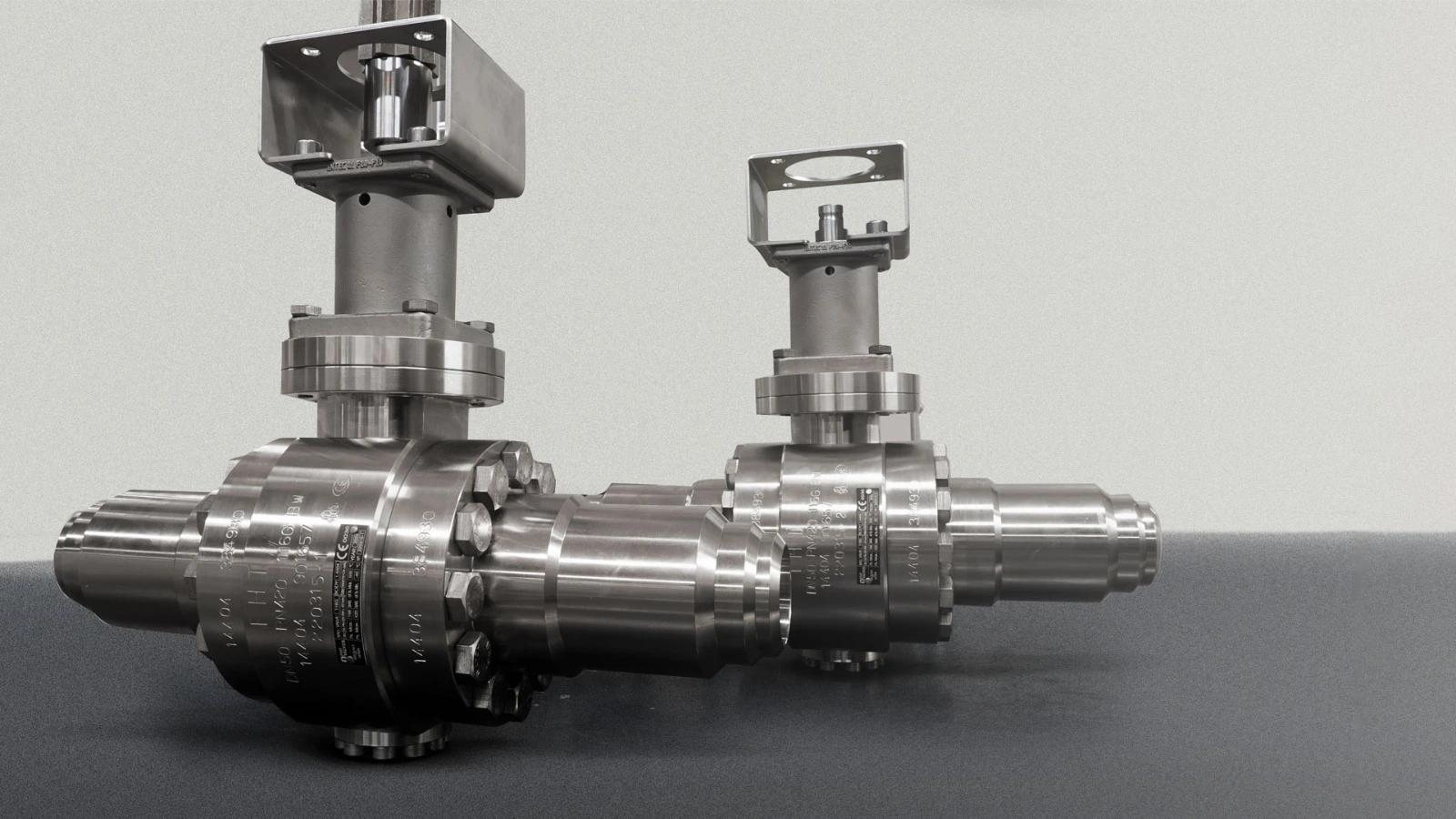
In oxygen service, the danger lies not in leakage but in ignition. Unlike other industrial gases, oxygen acts as an oxidizer: in the presence of traces of grease, oil, metal particles, or any residual hydrocarbon, even a minimal energy source — friction, adiabatic compression, or particle impact — is enough to trigger violent combustion inside the valve body itself. This is why degreasing is not an optional finishing step, but a fundamental requirement in the design and manufacture of ball valves for oxygen service.
Why Oxygen Requires a Specific Cleaning Process
A conventional ball valve may leave the factory with traces of machining coolants, assembly greases, or metal particles resulting from the manufacturing process. In most industrial services, these residues are irrelevant. In oxygen service, especially at high concentrations or pressures, any combustible residue inside the body, ball, or seat becomes a potential ignition point.
The risk increases with pressure and flow velocity. A sudden increase in pressure causes adiabatic compression of gas trapped in internal cavities, generating localized temperature peaks high enough to ignite organic residues. At higher flow velocities, the kinetic energy of solid particles suspended in the flow can also act as an ignition source when they impact metal surfaces.
Reference Standards for Degreasing
The degreasing process for oxygen-service ball valves is not left to the manufacturer’s discretion: it is governed by specific standards that define permissible materials, cleaning methods, and acceptable levels of residual contamination.
The main industry references are ASTM G93, which establishes cleanliness levels for components intended for oxygen service, and IGC Doc 13, published by the European Industrial Gases Association, which details degreasing procedures, compatible materials, and installation conditions. Both standards agree on one central point: the removal of hydrocarbons, particles, and moisture must be verified, not simply assumed.
What the Degreasing Process Involves in Practice
Degreasing an industrial ball valve for oxygen service covers all components in contact with the fluid: body, ball, seats, stem, and seals. The typical process includes:
- Hydrocarbon Removal: Oxygen-compatible solvents remove machining and assembly oils and greases without leaving any residue.
- Particle Removal: Mechanical and ultrasonic cleaning to remove chips, oxides, and solid contamination from internal surfaces.
- Moisture Control: Complete drying before final assembly, as residual moisture can promote corrosion and compromise subsequent cleanliness.
- Cleanliness Verification: Visual inspection under UV light or gravimetric analysis, depending on the cleanliness level required by the project specification.
Selection of Compatible Materials
Degreasing addresses surface contamination, but it does not replace proper material selection. Elastomers in contact with oxygen are restricted to compounds with low reactivity and ignition risk: in practice, virgin PTFE and FFKM are practically the only materials accepted. Valve bodies and metal components are generally manufactured from stainless steel, as it does not react or ignite when in contact with oxygen under normal service conditions.
The combination of compatible materials and a certified degreasing process is what ensures that the valve operates safely across its specified pressure and oxygen concentration range.
Documentation and Traceability
In oxygen projects, documentation of the degreasing process is part of the delivery just as much as the valve itself. This includes a cleaning certificate according to the applicable standard, material traceability, and, when required by the customer, photographic or analytical reports of the process. This documentation is commonly required by EPC engineering companies and process safety departments before accepting the supply.
At FHT Valves, ball valves for oxygen service are supplied cleaned and certified in accordance with these criteria, with complete traceability documentation covering materials and the manufacturing process.
Frequently Asked Questions
Why is it necessary to degrease a ball valve for oxygen service? Because any oil, grease, or combustible particle residue can act as an ignition point in the presence of pressurized oxygen, even in minimal quantities.
Which standards regulate degreasing for oxygen service? The main standards are ASTM G93 and IGC Doc 13, which establish acceptable cleanliness levels and degreasing procedures.
What materials are used in oxygen-service ball valves? Stainless steel bodies and low-reactivity materials such as virgin PTFE or FFKM, selected for their compatibility with oxygen.
Is degreasing a one-time process, or must it be repeated? It is a certified manufacturing process carried out before supply. If the valve is subsequently disassembled or serviced, degreasing must be repeated to maintain the cleanliness certification.
What documentation should accompany a degreased oxygen-service valve? A cleaning certificate according to the applicable standard and material traceability documentation, which are commonly required by engineering companies and process safety departments.