
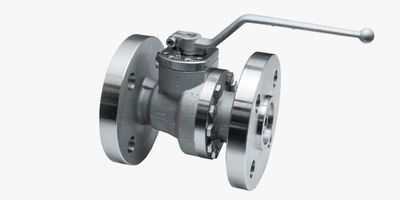
Ball valves with soft polymer seats for high temperatures make it possible to maintain tight shut-off and reliable dimensional stability in services that significantly exceed the practical limit of virgin PTFE. The compound used in these seats, known as Fluoro HT, has been specifically developed to operate at 300°C while maintaining much lower deformation under load than a standard seat.
This type of seat solves a recurring problem in thermal processes: conventional PTFE, although the reference material for soft seats due to its chemical inertness, loses dimensional stability above certain temperature and pressure thresholds, compromising valve tightness.
BUTTON –
What Is Fluoro HT Polymer and Why Is It Used in Ball Valve Seats
Fluoro HT is a special polymer compound designed for high-temperature applications where dimensional stability is a critical requirement. Unlike virgin PTFE, its formulation significantly reduces the phenomenon of creep under sustained load at elevated temperatures.
In a ball valve seat, dimensional stability directly determines the ability to maintain the seat preload against the ball. If the material deforms excessively, the seat loses effective contact and the valve begins to experience internal leakage, even when there is no apparent visible damage.
Material Composition and Behaviour
Fluoro HT maintains a base compatible with the applications commonly associated with PTFE, but with a modified structure that improves its mechanical behaviour at elevated temperatures. This makes it a direct alternative for replacing virgin PTFE seats in services where process temperature is the limiting factor.
Why Virgin PTFE Is Not Sufficient for High-Temperature Services
Virgin PTFE is a reference material for soft seats due to its chemical resistance and low coefficient of friction. However, under sustained load and elevated temperatures, it exhibits a level of deformation that can compromise long-term tightness.
Comparative tests carried out according to ASTM D261, applying a load of 3.45 MPa for 24 hours at 300°C, show a significant difference between the two materials:
- Virgin PTFE: deformation under load of 35% in the machine direction.
- Fluoro HT: deformation under load of 8% in the machine direction, under the same test conditions.
This more-than-fourfold reduction in deformation explains why Fluoro HT is specified for applications where virgin PTFE no longer provides a sufficient safety margin.
Technical Properties of Fluoro HT Polymer
The material properties are determined using standardised test methods, allowing its performance to be objectively compared with other compounds.
| Property | Test Method | Value | Unit |
| Tensile strength | ASTM D4745 | 10 min. | MPa |
| Elongation at break | ASTM D4745 | 100 min. | % |
| Specific gravity | ASTM D792 | 2.0 to 2.3 | g/cc |
| Hardness | ASTM D2240 | 60 – 65 | Shore D |
| Deformation under load (300°C, 3.45 MPa, 24 h) | ASTM D261 | 8.00 | % machine direction |
These values are generated from specimens moulded under standard temperature and pressure conditions and should be used as a comparative reference between materials. The actual performance of a component depends on its geometry and specific processing conditions.
Advantages of Ball Valves with High-Temperature Soft Polymer Seats
- Greater dimensional stability: less deformation under sustained load at elevated temperatures.
- More reliable long-term shut-off: the seat maintains the necessary preload against the ball for longer.
- Lower maintenance frequency: reduced material creep decreases the need for seat adjustments or replacements.
- Compatibility with existing processes: it can directly replace virgin PTFE seats in already validated designs without redesigning the valve body.
Industrial Applications of Valves with Fluoro HT Seats
The ball valves with this type of seat are used in processes where the operating temperature continuously exceeds the reliable operating range of virgin PTFE:
- Steam and condensate lines operating at elevated temperatures.
- Petrochemical processes with prolonged thermal stages.
- Heat transfer systems using oil or other heating fluids.
- Severe-service applications where seat creep is a known failure mode.
This type of seat is typically integrated into the range of special ball valves from FHT Valves, together with other configurations developed for process conditions outside the standard range.
How to Properly Specify a Ball Valve with a High-Temperature Soft Polymer Seat
Before selecting the seat material, it is advisable to define the following parameters precisely:
- Operating temperature, including peaks and transient conditions.
- Differential pressure in the line and load conditions on the seat.
- Nature of the fluid and its chemical compatibility with the polymer compound.
- Expected opening and closing cycles, as these affect seat wear.
An incomplete specification of these parameters is the most common cause of premature failure in soft seats exposed to elevated temperatures.
Frequently Asked Questions
What temperature can ball valves with Fluoro HT soft polymer seats withstand? Fluoro HT is designed to operate in services up to 300°C while maintaining reduced deformation under load, according to tests carried out in accordance with ASTM D261.
How does Fluoro HT differ from virgin PTFE? Fluoro HT exhibits 8% deformation under load at 300°C, compared with 35% for virgin PTFE under the same test conditions, resulting in greater dimensional stability and more reliable shut-off.
Can a PTFE seat be replaced with Fluoro HT without changing the valve design? In most cases, yes, as Fluoro HT maintains a geometry and mechanical behaviour compatible with existing seat designs for virgin PTFE.
Which standards are used to characterise the material properties? The mechanical properties are determined according to ASTM D4745 (tensile strength and elongation), ASTM D792 (density), ASTM D2240 (hardness), and ASTM D261 (deformation under load).
Which industries use valves with this type of seat? Mainly petrochemical, power generation, and processes involving steam, condensate, or thermal fluid lines where sustained temperature is a critical design factor.